 Add to Chrome
 Add to Firefox
 Add to Edge
CAIT: A Syntactic Parsing Toolkit for Child-Adult InTeractions
May 19, 2026
CHILDES is a paramount resource for language acquisition studies -- yet computational tools for analyzing its syntactic structure remain limited. Leveraging the recent release of the UD-English-CHILDES treebank with gold-standard Universal Dependencies (UD) annotations, we train a state-of-the-art dependency parser specifically tailored to CHILDES. The parser more accurately captures syntactic patterns in child--adult interactions, outperforming widely used off-the-shelf English parsers, including SpaCy and Stanza. Alongside the parser, we also release a Part-of-Speech tagger and an utterance-level construction tagger, which together form the open-source Syntactic Parsing Toolkit for Child--Adult InTeractions (CAIT). Through a detailed error analysis and a case study tracking the distribution of syntactic constructions across developmental time in CHILDES, we demonstrate the practical utility of the toolkit for large-scale, reproducible research on language acquisition.

Is Child-Directed Language Optimized for Word Learning? A Computational Study of Verb Meaning Acquisition
May 12, 2026Is child-directed language (CDL) optimized to support language learning, and which aspects of linguistic development does it facilitate? We investigate this question using neural language models trained on CDL versus adult-directed language (ADL). We selectively remove syntactic or lexical co-occurrence information from the model training data, and evaluate the impact of these manipulations on verb meaning acquisition. While disrupting syntax impairs learning across all datasets, models trained on CDL and spoken ADL show significantly higher resilience than those trained on written input. Tracking semantic and syntactic performance over training, we observe a semantic-first trajectory, with verb meanings emerging prior to robust syntactic proficiency, an asynchrony most pronounced in the spoken domain, especially CDL. These results suggest that the advantage for verb learning previously attributed to CDL may instead reflect broader properties of the spoken register, rather than a uniquely CDL-specific optimization.
Modeling Human-Like Color Naming Behavior in Context
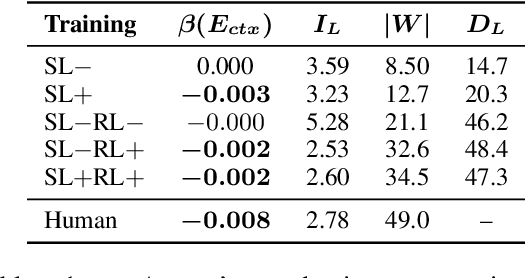
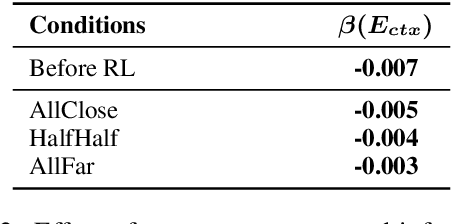
Apr 28, 2026Modeling the emergence of human-like lexicons in computational systems has advanced through the use of interacting neural agents, which simulate both learning and communicative pressures. The NeLLCom-Lex framework (Zhang et al., 2025) allows neural agents to develop pragmatic color naming behavior and human-like lexicons through supervised learning (SL) from human data and reinforcement learning (RL) in referential games. Despite these successes, the lexicons that emerge diverge systematically from human color categories, producing highly non-convex regions in color space, which contrast with the convexity typical of human categories. To address this, we introduce two factors, upsampling rare color terms during SL and multi-listener RL interactions, and adopt a convexity measure to quantify geometric coherence. We find that upsampling improves lexical diversity and system-level informativeness of the color lexicon, while many-listener setups promote more convex color categories. The combination of moderate upsampling and multiple listeners produces lexicons most similar to human systems.
Optimizing Language Models for Crosslingual Knowledge Consistency
Mar 04, 2026Large language models are known to often exhibit inconsistent knowledge. This is particularly problematic in multilingual scenarios, where models are likely to be asked similar questions in different languages, and inconsistent responses can undermine their reliability. In this work, we show that this issue can be mitigated using reinforcement learning with a structured reward function, which leads to an optimal policy with consistent crosslingual responses. We introduce Direct Consistency Optimization (DCO), a DPO-inspired method that requires no explicit reward model and is derived directly from the LLM itself. Comprehensive experiments show that DCO significantly improves crosslingual consistency across diverse LLMs and outperforms existing methods when training with samples of multiple languages, while complementing DPO when gold labels are available. Extra experiments demonstrate the effectiveness of DCO in bilingual settings, significant out-of-domain generalizability, and controllable alignment via direction hyperparameters. Taken together, these results establish DCO as a robust and efficient solution for improving knowledge consistency across languages in multilingual LLMs. All code, training scripts, and evaluation benchmarks are released at https://github.com/Betswish/ConsistencyRL.
A Unified Assessment of the Poverty of the Stimulus Argument for Neural Language Models
Feb 10, 2026How can children acquire native-level syntax from limited input? According to the Poverty of the Stimulus Hypothesis (PoSH), the linguistic input children receive is insufficient to explain certain generalizations that are robustly learned; innate linguistic constraints, many have argued, are thus necessary to explain language learning. Neural language models, which lack such language-specific constraints in their design, offer a computational test of this longstanding (but controversial) claim. We introduce \poshbench, a training-and-evaluation suite targeting question formation, islands to movement, and other English phenomena at the center of the PoSH arguments. Training Transformer models on 10--50M words of developmentally plausible text, we find indications of generalization on all phenomena even without direct positive evidence -- yet neural models remain less data-efficient and their generalizations are weaker than those of children. We further enhance our models with three recently proposed cognitively motivated inductive biases. We find these biases improve general syntactic competence but not \poshbench performance. Our findings challenge the claim that innate syntax is the only possible route to generalization, while suggesting that human-like data efficiency requires inductive biases beyond those tested here.
Assessing the Impact of Typological Features on Multilingual Machine Translation in the Age of Large Language Models
Feb 03, 2026Despite major advances in multilingual modeling, large quality disparities persist across languages. Besides the obvious impact of uneven training resources, typological properties have also been proposed to determine the intrinsic difficulty of modeling a language. The existing evidence, however, is mostly based on small monolingual language models or bilingual translation models trained from scratch. We expand on this line of work by analyzing two large pre-trained multilingual translation models, NLLB-200 and Tower+, which are state-of-the-art representatives of encoder-decoder and decoder-only machine translation, respectively. Based on a broad set of languages, we find that target language typology drives translation quality of both models, even after controlling for more trivial factors, such as data resourcedness and writing script. Additionally, languages with certain typological properties benefit more from a wider search of the output space, suggesting that such languages could profit from alternative decoding strategies beyond the standard left-to-right beam search. To facilitate further research in this area, we release a set of fine-grained typological properties for 212 languages of the FLORES+ MT evaluation benchmark.
Dialogue Is Not Enough to Make a Communicative BabyLM (But Neither Is Developmentally Inspired Reinforcement Learning)
Oct 23, 2025We investigate whether pre-training exclusively on dialogue data results in formally and functionally apt small language models. Based on this pre-trained llamalogue model, we employ a variety of fine-tuning strategies to enforce "more communicative" text generations by our models. Although our models underperform on most standard BabyLM benchmarks, they excel at dialogue continuation prediction in a minimal pair setting. While PPO fine-tuning has mixed to adversarial effects on our models, DPO fine-tuning further improves their performance on our custom dialogue benchmark.
NeLLCom-Lex: A Neural-agent Framework to Study the Interplay between Lexical Systems and Language Use
Sep 26, 2025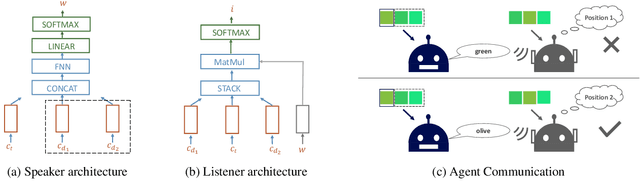
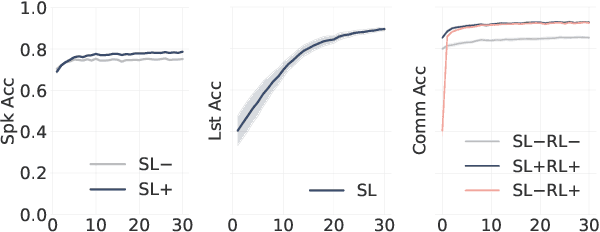
Lexical semantic change has primarily been investigated with observational and experimental methods; however, observational methods (corpus analysis, distributional semantic modeling) cannot get at causal mechanisms, and experimental paradigms with humans are hard to apply to semantic change due to the extended diachronic processes involved. This work introduces NeLLCom-Lex, a neural-agent framework designed to simulate semantic change by first grounding agents in a real lexical system (e.g. English) and then systematically manipulating their communicative needs. Using a well-established color naming task, we simulate the evolution of a lexical system within a single generation, and study which factors lead agents to: (i) develop human-like naming behavior and lexicons, and (ii) change their behavior and lexicons according to their communicative needs. Our experiments with different supervised and reinforcement learning pipelines show that neural agents trained to 'speak' an existing language can reproduce human-like patterns in color naming to a remarkable extent, supporting the further use of NeLLCom-Lex to elucidate the mechanisms of semantic change.
TurBLiMP: A Turkish Benchmark of Linguistic Minimal Pairs
Jun 16, 2025We introduce TurBLiMP, the first Turkish benchmark of linguistic minimal pairs, designed to evaluate the linguistic abilities of monolingual and multilingual language models (LMs). Covering 16 linguistic phenomena with 1000 minimal pairs each, TurBLiMP fills an important gap in linguistic evaluation resources for Turkish. In designing the benchmark, we give extra attention to two properties of Turkish that remain understudied in current syntactic evaluations of LMs, namely word order flexibility and subordination through morphological processes. Our experiments on a wide range of LMs and a newly collected set of human acceptability judgments reveal that even cutting-edge Large LMs still struggle with grammatical phenomena that are not challenging for humans, and may also exhibit different sensitivities to word order and morphological complexity compared to humans.
Child-Directed Language Does Not Consistently Boost Syntax Learning in Language Models
May 29, 2025Seminal work by Huebner et al. (2021) showed that language models (LMs) trained on English Child-Directed Language (CDL) can reach similar syntactic abilities as LMs trained on much larger amounts of adult-directed written text, suggesting that CDL could provide more effective LM training material than the commonly used internet-crawled data. However, the generalizability of these results across languages, model types, and evaluation settings remains unclear. We test this by comparing models trained on CDL vs. Wikipedia across two LM objectives (masked and causal), three languages (English, French, German), and three syntactic minimal-pair benchmarks. Our results on these benchmarks show inconsistent benefits of CDL, which in most cases is outperformed by Wikipedia models. We then identify various shortcomings in previous benchmarks, and introduce a novel testing methodology, FIT-CLAMS, which uses a frequency-controlled design to enable balanced comparisons across training corpora. Through minimal pair evaluations and regression analysis we show that training on CDL does not yield stronger generalizations for acquiring syntax and highlight the importance of controlling for frequency effects when evaluating syntactic ability.